


Restorative Yoga
Supported postures, held for minutes, with almost no effort.
Practice Coming Soon
Subscribe if this is something that you would like to know more about and receive updates as soon as we launch.
What is it?
Restorative yoga is a quiet practice of supported postures. Blankets, bolsters, pillows and blocks fill the gaps under the body so it can rest fully. You stay in a shape for about 5 to 20 minutes. There is no muscular effort, and stretching is not the aim.
The style usually meant by this name comes from Judith Hanson Lasater, a student of B.K.S. Iyengar. She took his use of props and turned it towards rest. In a Kripalu interview she describes the work as teaching people to lie down and let go of tension: more stillness than strength. Jillian Pransky, writing for Yoga Journal, puts the same point plainly. A restorative pose uses no muscular effort. There is no goal of stretching or strengthening. The props are there so you can release the grip of holding yourself up.
People practise it for that rest. A vigorous class such as Ashtanga or Vinyasa asks for repeated movement and muscle. Restorative asks for almost none. It suits a day when you are tired, sleeping badly, anxious, or injured and cannot do a strong class. Beginners and experienced students both use it. Simple does not make it a lesser practice.
Liis Ugandi teaches it at Goyoga Tallinn, in Estonian and English. She calls it taastav jooga, a yoga of happiness: breath and relaxation, stress easing, the mind settling. In her teaching she has seen regular practice ease stress, anxiety, panic, poor sleep and some pain, and a feeling of being able to start again. That is her classroom experience, not a promise that one class will treat those things.
This is a group class at Narva mnt 7D. It is not a medical appointment, and it is not yoga therapy as the International Association of Yoga Therapists (IAYT) defines it: a professional relationship with a personal assessment, goals and a plan for that person. A restorative class can be part of how someone uses yoga for recovery. It does not diagnose, and it does not replace a clinician.
Who is it for?
Restorative yoga and yin
Yin, in the form taught by Paul Grilley and Sarah Powers and described by Bernie Clark, holds floor poses for several minutes so a mild stress can reach connective tissue: fascia, ligaments, the area around the joints. You stay near a sensation, an edge, while the muscles stay quiet. Clark is clear that yin is not restorative yoga. Restorative yoga does not try to load the tissues, and it does not take you outside a comfortable shape.
Props in yin change the angle. Props in restorative yoga hold you up so you can stop holding yourself. At Goyoga, yin is its own class. Yoga Journal's comparison puts the usual restorative hold nearer 10 to 20 minutes, with the quiet of savasana in each shape. Liis uses about 5 to 20.
Restorative yoga and Yoga Nidra
Yoga Nidra is a guided lying meditation. You stay in one position, usually on your back, and follow a voice through the body, in the space between waking and sleep. Restorative yoga is a few supported postures. You may be on your back, your front or your side, arranged on props, and you rest in the shape.
The two can sit next to each other in a week. They are not the same hour.
Restorative yoga and a vigorous class
Ashtanga and Vinyasa build heat through repeated movement and muscular work. Restorative yoga does the opposite. A typical hour is only a few shapes, each held long enough that effort drops away. You will not sweat for fitness. If that is what you want, this is the wrong room.
What this class is not
It is not a workout. It is not a private yoga therapy session, and it is not medical care. Comfort is the standard: if a shape needs effort, or starts to hurt, it is not set up yet.
Better sleep, less pain or a lighter mood, when they happen, are things Liis has seen with regular practice. They are not a result the studio can guarantee, and they are not a reason to skip medical advice.
Key Benefits
Rest with almost no effort
The body is held by props. You are not asked to stretch, strengthen or keep up with a flow.
A class you can do when you are tired
Useful when a strong practice is too much, including poor sleep or a body that is run down or injured.
Breath and a quieter mind
Liis teaches the hour as breath and relaxation. Stress can ease and the mind can settle. That is the aim, not a clinical result.
What to Expect
● How a class feels
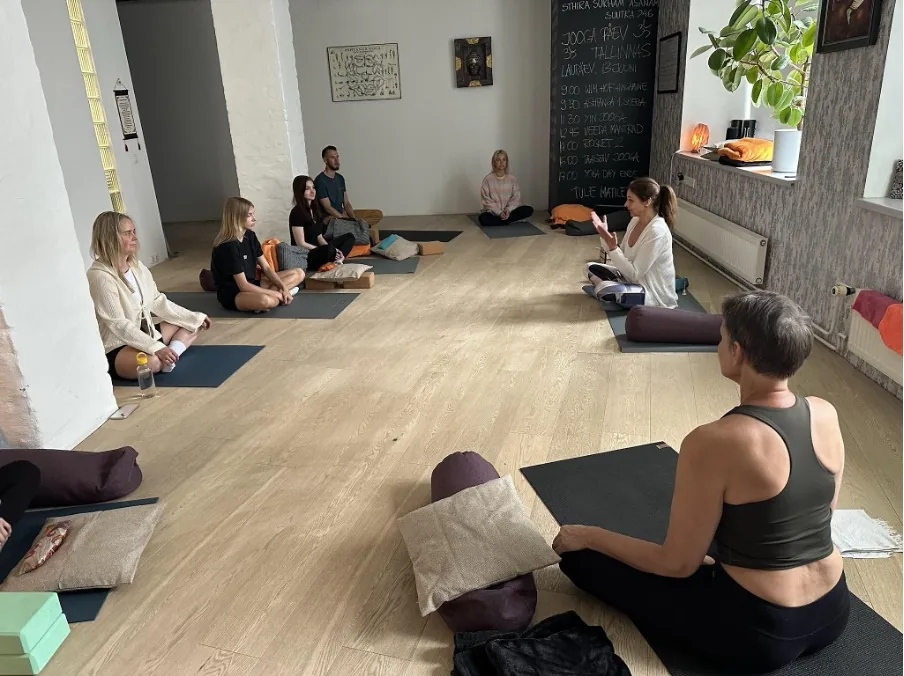
You take a mat and set the props so the body is fully supported. Liis helps you get comfortable. Then you stay. A shape might last 5 minutes or closer to 20. Breathing stays ordinary. There is nothing to achieve in the pose. Many people feel heavy, warm and a little slower afterwards. Some feel able to start again. Some feel very little in the room and notice the difference later, in sleep or the next day. Both are ordinary. One student, Merilyn Anette, wrote that she could relax, let go of built-up tension, and leave calmer.
● Props at the studio
Mats, blocks, straps, blankets, bolsters and pillows are at Goyoga Tallinn, Narva mnt 7D. You do not need to bring your own. Wear clothes you can lie down in. Mention pain, pregnancy or a recent injury before the class so the setup can change. Classes are in Estonian and English.
● Where it sits in the week
People use it beside stronger practices. A week can hold Ashtanga or Vinyasa and still need an hour where the body is not asked to work. Yin has a different job: a mild edge in the tissues. Yoga Nidra is guided rest on the floor. This hour is the supported shapes. Times are on the schedule .